
By Tom Rue | The Adelaide Branch / Mary Douglas Biography Project
I. Executive Summary: The Dual Career of Mary A. Douglas
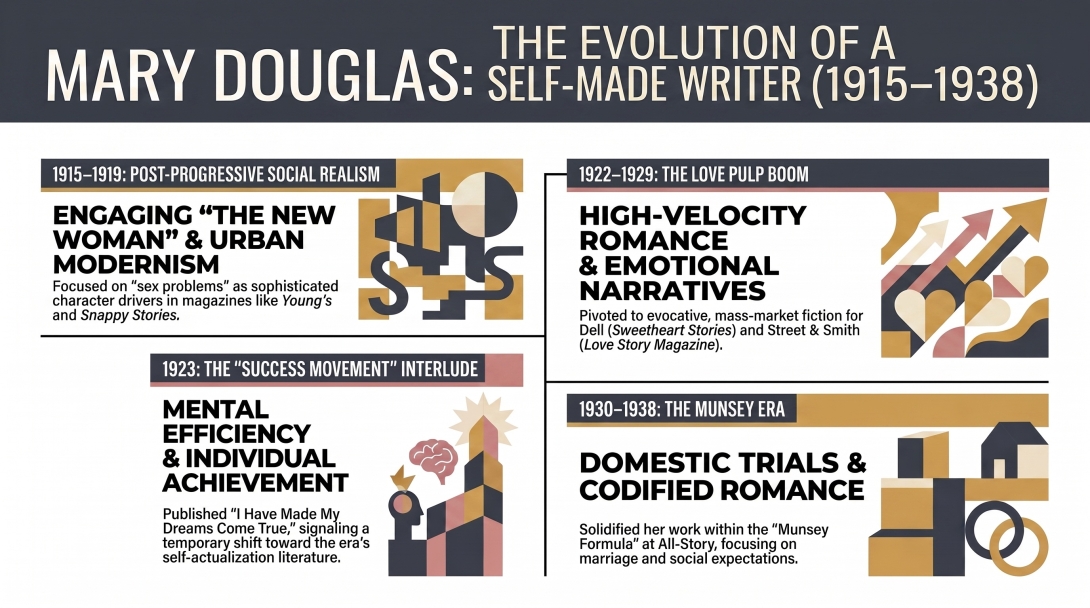
Following her 1913 rescue from Melvin H. Couch's secret law office partition in Monticello, New York, Adelaide Mary Branch (1873–1948) adopted the reclaimed identity Mary A. Douglas. Over the next three decades, she navigated two distinct spheres of American publishing: high-minded Progressive Era social critique and commercial pulp fiction.
This comparative analysis contrasts her landmark 1917 feminist essay, "What the World Owes to Spinsters" (published in Mitchell Kennerley's The Forum), with her 1930 commercial romance story, "A Silent Altar" (published in Frank A. Munsey's All-Story). Together, these works illustrate how an unmarried, self-supporting woman adapted her literary talents to achieve economic autonomy during the Great Depression.
II. The Radical Realism of "What the World Owes to Spinsters" (The Forum, July 1917)
In July 1917, writing as Mary A. Douglas, she published a fifteen-page manifesto in The Forum (Vol. 58, pp. 99–113) deconstructing patriarchal marriage and Victorian stigmas surrounding single womanhood. Drawing directly from her lived trauma of fifteen years of hidden cohabitation and unpaid secretarial labor in Monticello, Douglas inverted the traditional paradigm:
- Intensive vs. Extensive Labor: She argued that traditional marriage bound a woman to "intensive" labor—orbiting exclusively around the personal comfort and career of a single man. In contrast, the "spinster" exercised "extensive" labor, directing her intellect and empathy outward toward social reform, education, and public service.
- Economic Independence: Douglas celebrated single women as vital economic and cultural contributors who refused to trade personal autonomy for financial shelter.
III. The "Munsey Formula" and 1930s Pulp Fiction ("A Silent Altar," All-Story, Oct 1930)
By 1930, living in Morningside Heights and Washington, D.C., Douglas adapted her prose to the lucrative market of mass-circulation "love pulps." In "A Silent Altar" (All-Story, October 4, 1930), she embraced the emotional intensity and rapid pacing required by the Frank A. Munsey Company:
- Formulaic Romance Dynamics: Centering on a dramatic love triangle between Rosamond, Dick, and Cory, the narrative employs pulp tropes—high-stakes melodrama, emotional self-sacrifice, and swift moral resolution.
- Pulp Productivity as Economic Survival: While her 1917 essay challenged marital conventions, her 1930s stories provided the steady, reliable income needed to maintain financial independence during the Great Depression, alongside her typing agency work for Columbia University faculty.
IV. Comparative Analysis: 1917 Essay vs. 1930 Pulp Story
| Analytical Category | "What the World Owes to Spinsters" (1917) | "A Silent Altar" (1930) |
|---|---|---|
| Genre & Outlet | Feminist Essay / Social Critique (The Forum) | Commercial Romance Fiction (All-Story) |
| Target Audience | Progressive intellectuals, reformers, literary elite | Mass-market working-class readers, romance pulp subscribers |
| Core Ideology | Rejection of domestic servitude; celebration of single female autonomy | Emotional melodrama, romantic self-sacrifice, traditional resolution |
| Economic Function | Intellectual self-reclamation & public advocacy | Commercial "bread-and-butter" income during the Great Depression |
V. Conclusion: The Legacy of Mary A. Douglas
Mary A. Douglas's literary career demonstrates the resilience of a Progressive Era woman who refused to be defined or destroyed by public scandal. Whether publishing radical essays in The Forum or popular serials in All-Story, she maintained absolute economic self-reliance, earning her own living through the power of her pen and typewriter until her death in 1948.
```
Tags
- Log in to post comments